If emissions are needed because there aren’t enough uploads, the obvious solution is spending that same budget on uploading something of value.
Both emissions and uploads get tokens into the hands of hosts. However, uploading data is helping to grow the network through nodes behaving positively. Moreover, there is a useful bi-product of actual data being available for user consumption too.
I’d be interested to hear arguments against this approach. I can’t think of any, assuming the data isn’t pure junk and even if it was, at least it would be building a stronger network. Assuming the data has some value, then the benefit is multiplied.
On the flip side, I can think of many arguments against emissions.
Perhaps the look of a huge amount of available storage and participation is considered a selling point, it may be, to who though?
Emissions are needed to get the network on it’s feet seems to miss what on it’s feet is.
I would consider a much smaller network that is functioning on supply and demand, running on SPARE RESOURCES, and a growing community on it’s feet.
Why do we need to pretend to be this huge network of millions of nodes, the entire community and the only users of the network know it is fake and disingenuous.
A few are happy to earn emissions and will of course be happy to support it.
Optics are important, it feels like we will look hollow to outsiders for doing this, feels hollow to me.
The USP of a network run on abundant spare resources is out the window and not only is the network largely run in data centers, it is incentivised.
What are we doing?
What are we? A way to store and retrieve encrypted data distributed among various data centers?
Reading through real quick, might have missed something. But we’re effectively already subsidizing uploads with emissions (indirectly).
The emissions are resulting in more nodes running, equaling lower network fullness, effectively lowering the cost per MB upload drastically.
if we were to turn off emissions, nodes would turnoff, uploads would become more expensive, and therefor uploads would be paying more, resulting in more ANT in the hands of node operator’s. The question is, do we want to subsidize uploads, or do we want to prevent the network from becoming full and thus to expensive for people to want to upload. I think it’s the last.
Maybe because fees are 1000x the ant price and the price dynamics don’t get into action at all… And prices (due to fees) are higher than the price point would level out… Just a theory =D
I believe there’s a logical error in framing the question as “subsidizing uploads vs. preventing the network from becoming full.” These are not our ultimate goals, and this is a false dilemma.
Our true goals are:
To make nodes do the actual work they were created for.
To pay only the nodes that are doing this work – storing and retrieving data.
To observe and demonstrate the network’s functionality and its pricing mechanism under real-world conditions.
To demonstrate the network’s utility with real data, moving beyond promises.
A perpetually empty network sustained only by emissions is a sign of failure, not success.
As @Traktion rightly noted, “If data of value does start to offset emissions, then the damage can be limited.” This is the key. We need to tie emissions to value creation to break the death spiral.
This doesn’t mean we recklessly spend. The amount of data uploaded can be carefully regulated and scaled by the Foundation. Furthermore, to smoothly transition nodes to this new model, the Foundation could use a portion of the emissions to provide bonus rewards to nodes that have just been paid for storing real data.
This way, emissions are no longer a “subsidy for existence” but become a “performance bonus for useful work,” creating a virtuous cycle where value offsets inflation.
One option would be to pay for uploads to archive any YouTube channel with a minimum number of followers in exchange for promotion of the Autonomi based backup to subscribers (e.g. “This channel is now available permanently on the censorship-resistant ‘Autonomi’ network”).
Marketing + token issuance + real work for nodes + getting popular data on the network all in one. Far better than subsidising excessive nodes at the expense of token holders with pretty much zero value provided.
I like this idea too because it means emissions don’t do anything unless nodes are filling up beyond a level that is considered ideal, allowing the market to work properly & only kicking in to ‘boost’ market signals during high demand to ensure node operators more quickly increase supply respond to increases in demand for storage.
Absolutely.
Indeed. I hope the team can have a proper critical look at emissions and consider how the supply allocated to them could be used to do so much more good than they are currently planning to do with them.
The remainder of 240,000,000 tokens could potentially be used to add serious value by doing one or a combination of:
Funding the upload of large quantities of strategic valuable data, e.g. backing up valuable YouTube channels, public archives among other things, massively boosting the utility of the early network, and raising awareness of Autonomi to significant audiences
Be sold in a deal to fund an app-dev team with a specific focus on marketing & user experience to work with community devs to make focused apps with a real addressable market & great user experience, leveraging the capabilities already demonstrated by community devs etc. This could make very usable apps available to specific markets that could gain traction for the early network, and give support that adds value and recognition to the huge contribution of community devs.
Be released only when nodes are above a certain fullness level (e.g. 75%) to ensure incentives to start new nodes are strong, maintaining supply when demand is weak and boosting it only during times of strong demand
… or they could purely be distributed to nodes according to the current plan, missing the opportunity to create additional value.
As well as creating no value, there’s the added down sides of reducing the clarity of pricing signals to nodes & eroding token value over time.
An over-supply of nodes is never required; node operators have already shown they’ll very quickly respond to incentives, and this will include the slowly rising price that results from increases in demand starting to fill nodes.
Anyway, while still a missed opportunity, the emissions issues will be less relevant once the ETH cost is massively reduced and nodes start to fill up with a proper market for resources emerging.
No - because it seems that fees alone are enough to make people holding back with uploads atm - right..? So if ant price would add up onto that this would mean even less demand…
If incentives went to subsidize uploads instead of nodes doing nothing we get a fully working and tested system, no?
And if those incentives brought developers in instead of empty nodes they bring users in who may be happy to pay a slight premium for cutting edge tech as it settles and gets cheaper.
Here is a (slightly outdated) archive of all Davids activity on Discord.
Im putting this up so there is no doubt about what wwas said when - and because there are many tech gems and good explanations in there too
Im doing similar for @Bux and @JimCollinson across all the Discord channels. Problem is the extraction process is VERY slow so weekly updates are the best I can manage. Its been 4hrs+ to get the last weeks output gathered and its still not quite finished yet
Lets face helping uploading with emissions will and cannot work at the moment. 16K emissions a day is like 300$ and that would be squat in terms of uploads. Meaningless for incentivising people to run nodes.
With a small network we need emissions to encourage people to run nodes on their own machines. Emissions at this time are high enough in quantity and nodes cheap enough to run that the leeches are maximising ROI by shutting down and resetting large portions of the network.
The real problem is not the price as emissions has little effect on that in reality, but is the leeches being fuelled to abuse the network. It is the abuse that is the REAL problem. That update focused on the problem being token price. IE don’t look at the problem, look over here. Don’t upset our perfect plan we are so proud of.
I’d like to remind some people “Pride goeth before a fall” No plan is so perfect you can be proud about it, all plans need to be revised over time as new conditions crop up. A plan that cannot adapt to pitfalls is doomed to failure no matter how proud you are of it.
If I understood your arguments correctly, I would like to respond to you as follows:
You correctly identified the symptom — abuses by ‘leeches’. But perhaps we disagree on the diagnosis and the treatment.
You see the cause in the high emission attracting ‘leeches’. I, however, see the cause in the fact that the emission is not tied to useful work, which is what creates the very possibility for abuses.
Payment is conducted in tokens, not in dollars. You estimate the emission at $300, but that is secondary. The cost of uploads on the network is determined in tokens, and the price of an upload falls as the token price falls and as the number of nodes in the network grows. The question is not about the absolute dollar value of the emission, but about what it is spent on. Right now, it is spent on supporting “leeches,” while it could be spent on paying for the storage of real data.
The mechanism of protection is real data. You say that ‘leeches’ are a real problem. I agree with that. But it is precisely the uploading of data into the network that is the very mechanism which protects the network from empty nodes. A network that has demand for storage will prioritize and reward those nodes that store real, in-demand data. ‘Leeches’ with their constantly restarted empty nodes simply will not receive work, as they have no reputation or reliability, and they will constantly miss the opportunity to receive the next data upload into the network and the payment for it.
The proposed solution is not simply to ‘help with uploads’ and financially support node operators, but to change the very logic of rewards through the Foundation’s emissions. Instead of paying everyone just for being present on the network, we need to direct these same tokens to pay for specific work. This will not increase inflation — we are redirecting the existing flow of emission.
Thus, we solve both problems at once:
The problem of ‘leeches’: We deprive them of the economic model based on inflating the count of empty nodes.
The problem of value: We begin to create real demand and utility for the network, which in the long term is the only cure for the price decline.
Pride is indeed dangerous, and it is even more dangerous to stubbornly cling to a model that is already demonstrating clear systemic flaws and to not dare to adapt it.
I confess that I have been selling lately - which I hate, but I really have to do because I’m not a hypocrite - I don’t believe the token or the network will survive with current direction.
As I have been selling I can say something about market depth - despite the volume numbers, which must be fake, their is no depth to the market and selling of 16,000 tokens per day in combination with old hodler’s like me also selling some small amount per day, is dropping the price a lot - I have to put hard limits on how much I sell at any point or I will literally crash the price of ANT. So that 16,000 tokens per day that @neo mentioned as being current emissions (I assume it’s the correct number) IS strongly influencing the price.
If emissions increase, as is the plan, then this will only get worse. The cost of uploading in tokens will keep going up, eventually, as crazy as it sounds, it will take all the tokens of the entire network to pay for a single MB if people keep selling (and there is no incentive to hold when the supply is being diluted) … of course before it get’s so such a crazy level, the network will be dead.
There needs to be a reason to hold tokens to reverse this.
stop diluting the supply - do this first. This will stabilize the price as nodes will have fewer tokens to sell and former hodler’s like me will stop selling as well - I would even start buying again.
develop a marketing plan that targets investors - they can be brought into the market if we have a stable token that isn’t being diluted because our market-cap is much lower than other storage tokens - yet our tech is very good by comparison and we can leverage this in marketing to bring investors in who will see the major profit potential of the token at these low prices.
only after #1 and #2, and when maidsafe and foundation are ready, then market to end users and facilitate investors to market to end-users as well with marketing materials packages.
If the management follows my advice we will pull up from this value-nose dive. If they do not change course, the network is doomed and it won’t take long - a year at most I expect before collapse.
BTW, if all the tokens set aside for emissions were BURNED, this would create huge confidence in the project and it’s future for all hodlers. Even nodes would start hodling and they would start marketing the network too.
In short, if the token has long term value, then the network has long term value and everyone will become a voice and so a marketing force for the network which will drive development and adoption.
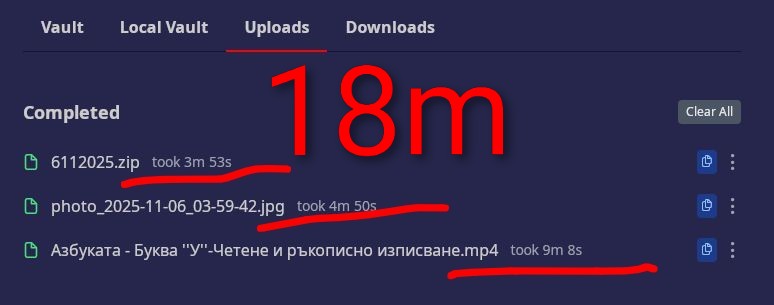
No, I currently pay 1-10 cents for uploading 3 files and about 20-30 minutes of human time per day. I can forgo 1 coffee a day and upload x10 more files - i.e. every day I can upload 1 playlist with music or video clips that we can share with friends and demonstrate the power of the network. What I can’t forgo is x10 more time… I.e. what is currently stopping the network from filling up is the physical human time for uploading data.
The current direction includes, among other things:
slashing fees to make uploading cheaper & remove the ETH bottleneck on the economy
Removing the need for ETH to upload with Paymasters
Making integration with Android and iOS far easier with mobile SDKs
Community devs releasing and improving various apps that make the network useful and interesting
I feel this is all significant and will lead to momentum starting to build with the ecosystem.
Once the fee block and UX blockers are out of the way, I think things can start to build and marketing would also become easier and more effective. This could be happening within 2-3 months if all goes well.
One momentum with apps & UX is snowballing, belief will increase & it won’t take much demand to reverse the token price trend.
Doesn’t seem like the network is heading to death and destruction to me… quite the opposite!