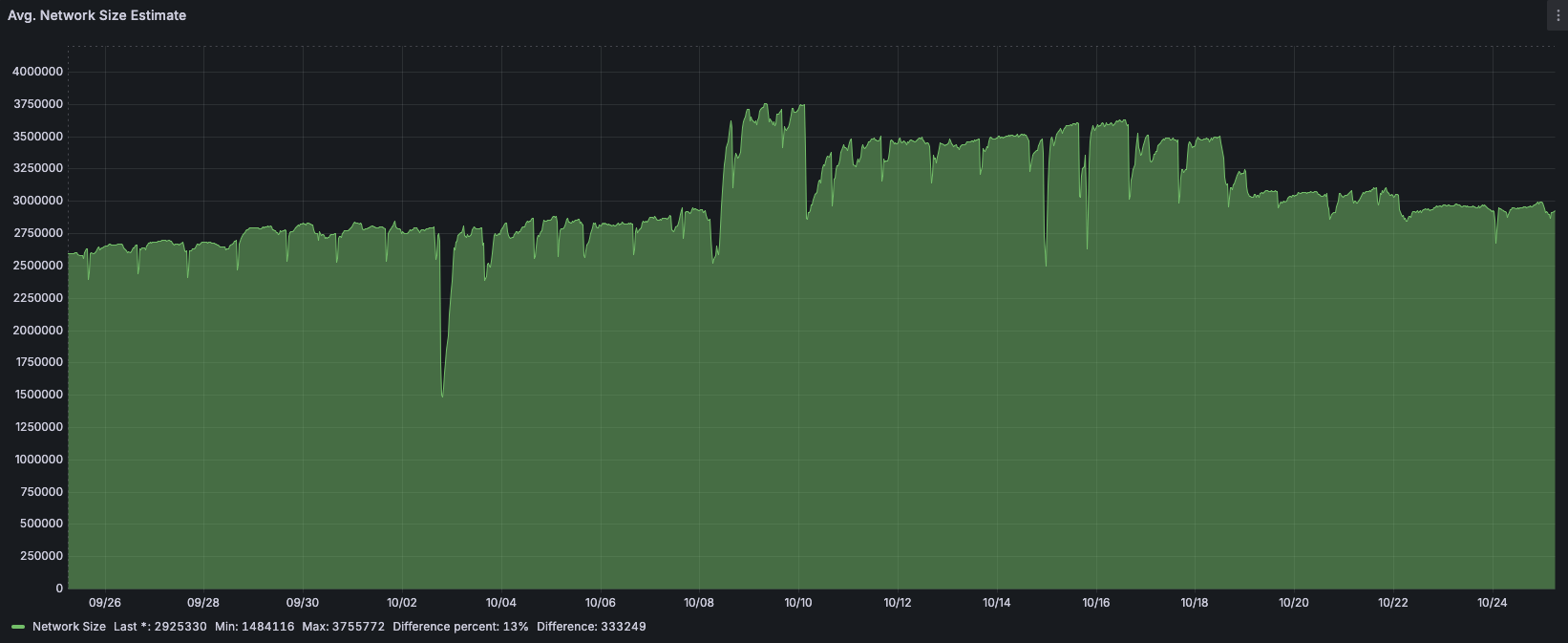
Everything indicates that the decline in the number of nodes in Autonomi occurred even before the AWS failure, which would mean that the network was not affected in any way by the problems that affected many services around the world.
I am not sure if this is representative given the size of the network, but this event indicates that Autonomi is highly stable and resilient to failures.
The AWS outage happened on Oct 20th, and from our sample of 200 nodes, and past 30 days off data, and zooming in on Oct 20th (24 hour period), it did not make a noticeable dent in network size drop:
Thank you for sharing the details. I spoke with Qi_ma earlier, and he said that the nodes were disconnected at around 3:00 p.m. on 18 Oct, and that the AWS failure occurred much later, but now it appears that the failure clearly had no impact on the network.
This is great news. Although Autonomi is still a very small network today, one can assume that even if it were, say, 100 times larger, it would not lose any nodes because it uses its own protocol.
Assuming that the failure occurred at the level of the cloud service provider, i.e. AWS, and not at the level of the internet service provider, the Autonomi nodes could demonstrate resilience and the network would continue to operate without failure. However, if there were a global failure, e.g. Orange, then the nodes could be disconnected and this situation would affect the operation of Autonomi. I think it would be worthwhile to hear the team’s opinion on this matter.
If nodes are being run on AWS infrastructure they can be affected by various problems at AWS.
We know a lot of nodes are being run in “the cloud” and can expect this to continue. Maybe there aren’t many on AWS, or maybe they are running on systems that were not affected. We don’t really know.
It’s good that the network wasn’t affected but that doesn’t mean it is immune to problems at cloud providers. It all depends,
So it is important to gather information and use that, but we should not make incredible claims. because the people who care about this will see through them and lose trust in all claims.
This is one of the points that already apply to using a server based setup to demonstrate Autonomi. It really doesn’t, and misrepresentation is bad marketing. It only works for fly by night operators.
Would you be any closer to being a happybeing if every page served up by anttp.sntsnest.site and similar carried a banner/link^ to indicate that this is a TEMPORARY solution until we can get get everyone using anttp/dweb locally or they install the client?
^The details of this are an ecumenical matter of course and we must defer to Bishop @safemedia or Cardinal @Traktion for full enlightenment.
Yesterday, we experienced another outage at Microsoft Azure, a global cloud platform service provider. For several hours, starting at around 5 p.m. European time, there were “DNS issues” – the same cause that led to a massive AWS outage last week. Microsoft explained that the source of the problems was a failure of the Azure Front Door (AFD) service, which is responsible for managing internet traffic and service availability.
@yeezy, did Autonomi record any above-standard node disconnections yesterday afternoon and evening? Could you share data similar to that from five days ago after the AWS failure?
Not surprised. Ouch. Vendor lock in is the worst thing ever.
I am surprised the user never decided to keep local copies of all their data in a non apple proprietary format. I have an apple laptop but no external subscription based features…
It is what it is. I wish a better outcome for that user, but probably unlikely (probably some security mechanism that cannot be undone just for 1 individual as an exception (who knows)).